Relational Group Therapy Maine: Why I Started a Therapy Group (And What Happens Inside It)
Group therapy is a format of therapy that people tend to overlook when they are looking for a therapist. I can see how many would find it intimidating in comparison to individual therapy: sharing your secrets with a room full of strangers is definitely terrifying, as opposed to one trusted confidant who is bound by confidentiality. However, as a therapist offering relational group therapy in Maine, I deeply believe that group therapy is the most effective format of therapy, both in terms of cost and impact, compared to individual therapy.
There is a wide range of different therapy groups out there, so to keep things simple, I will describe the therapy groups I facilitate in my practice, which are process groups (or Relational Process Groups, as I call them).
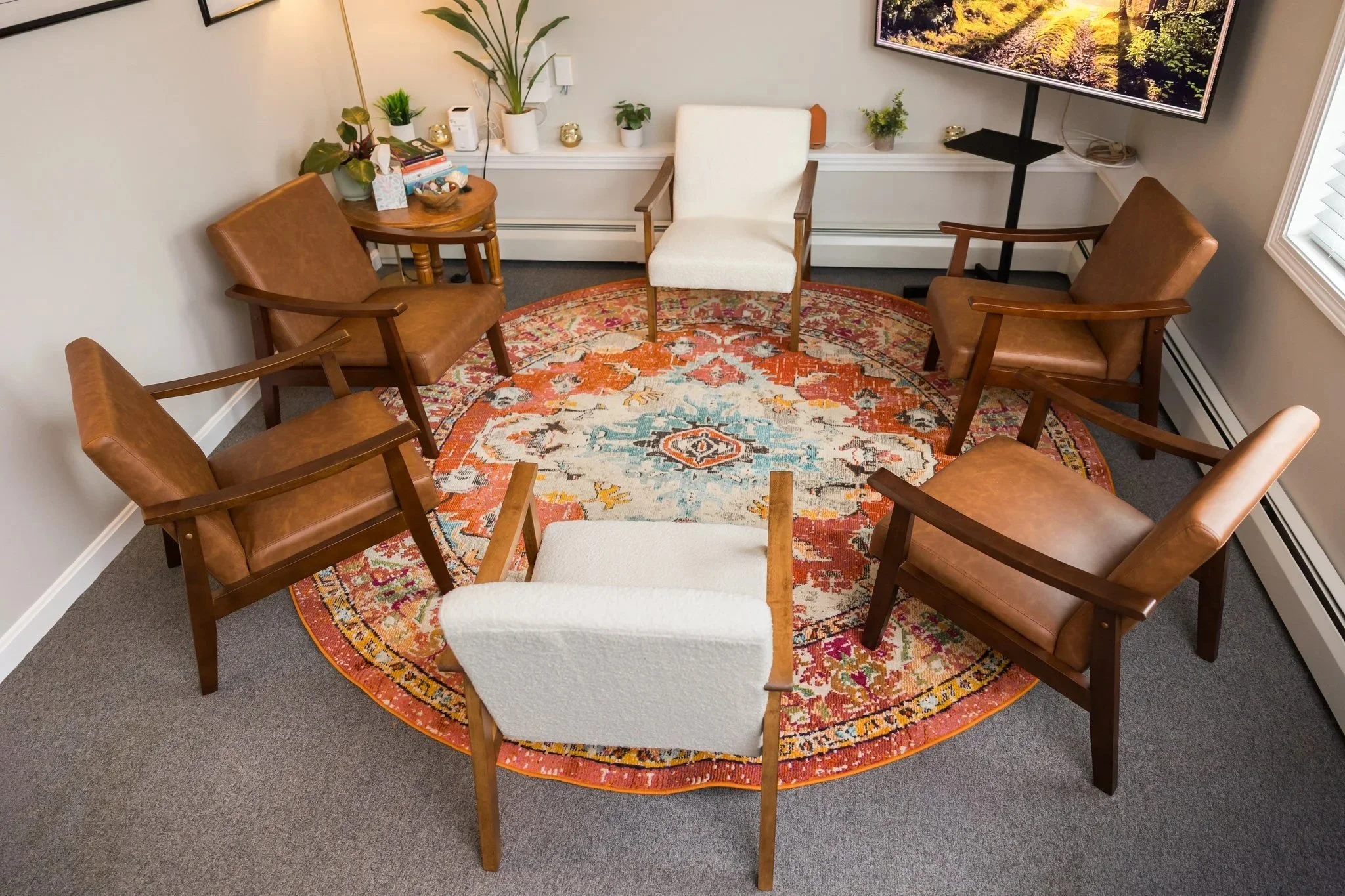
Group therapy chair circle in Emily Hope Counseling office space, located in Windham, Maine
What Is Relational Group Therapy?
In relational therapy, the fundamental belief at the core of the therapy is that human beings are shaped and influenced primarily by relationships. The majority of our perpetuating issues derive from the connection (or lack thereof) we have with others in our lives, and we look at how that may have began very early on in childhood. When using this approach in a group therapy format, most therapists utilize a structure called “process groups.” Process groups typically contain 3–7 group members at any given time, plus the facilitator who is usually a licensed therapist.
In a process group, group members build relationships with one another by sharing bits of our stories and lives, and over time we begin to see our similarities mirrored in others who on paper we may have never guessed that we could share commonalities with.
Group members usually come into group feeling isolated and as if their problems are so unique that nobody else could ever relate to what they are going through. The process of relating to one another in the group setting often leaves us feeling surprised to find that more often than not, our experiences as human beings are more alike than they are different.
This concept, called universality, instantly helps us feel less alone in our humanity and gives us a sense of belonging and hope that things will get better.
Why Group Therapy Can Be So Powerful
In addition to the concept of universality, what I find fascinating about group therapy is the ways in which how we show up in the world is reflected back to us.
This can be an incredibly beautiful and challenging growth experience.
On the one hand, our group members, who over time develop care for one another, see both the parts of each other that are easy to be around ("you're so much funnier than you think you are!") and the parts of themselves that are showing up in relationships as barriers for deeper connection ("when you shy away and fear taking up 'too much' space, I'm less drawn to you. When you get honest and start venting, I just want to hear more and more of what you have to say!")
If it sounds scary, that makes complete and total sense.
In group, people can be both brutally honest but in a compassionate way that actually supports you in moving towards healthier ways of relating and having authentic relationships.
The Healing Power of Process Group Therapy
Group therapy is powerful because the important relationships in your life can be worked on through others: someone who may feel like an older sister, the mom you always wanted, the grandmother you wish you had, or the friend you lost may show up symbolically in the room.
Someone in the group may trigger you, reminding you of the sassy boss who you always feared and with whom you never knew how to advocate for your needs.
All of these people may show up in your psyche in the room, and with a new group member, you may get to have a corrective experience where you practice setting a boundary or having the conversation you always wished you had had.
Why I Started Offering Relational Group Therapy in Maine
I started a Women's Relational Process Group for adults 23+ in Windham, Maine because I noticed that there were many therapists in the Sebago Lakes Region area outside of Portland, Maine that were offering online therapy via telehealth and groups, but not many in-person groups.
Having offered groups in community mental health in Massachusetts, I saw the power of group therapy and the ways in which it helped people move closer towards whatever mental health goals they were working on.
Even more special were in-person groups and the feeling of magic that was viscerally felt when physically sitting in connection with others.
Building Connection After the Pandemic
Since the pandemic, so many of us have felt isolated and a sense of "social atrophy," as Esther Perel calls it.
While online groups are definitely more accessible, I am offering this group as an in-person experience to help those in the community who are looking to exercise their relational muscles.
For those looking for group therapy near Portland, Maine, our group meets on Wednesdays at 6:00 PM for 90 minutes as we touch on a variety of relational themes, including:
Codependency
Boundaries
Assertiveness
Mother and father wounds
Unavailable partners
Friendships that are no longer serving us
Finding a fulfilling career
Building a life that brings you joy
Interested in Joining a Group?
In the fall, we will open up our group once again for the Fall Sessions, and better yet, I will also be offering a Men's Group on Thursday evenings.
If you are interested in learning more about relational group therapy in Maine, process group therapy, or joining a therapy group in my practice, Emily Hope Counseling, feel free to leave a comment below, email inquiries@emilyhopecounseling.com, or join our waitlists for Fall Sessions through our website.
Photography by: Marissa Elise Photography